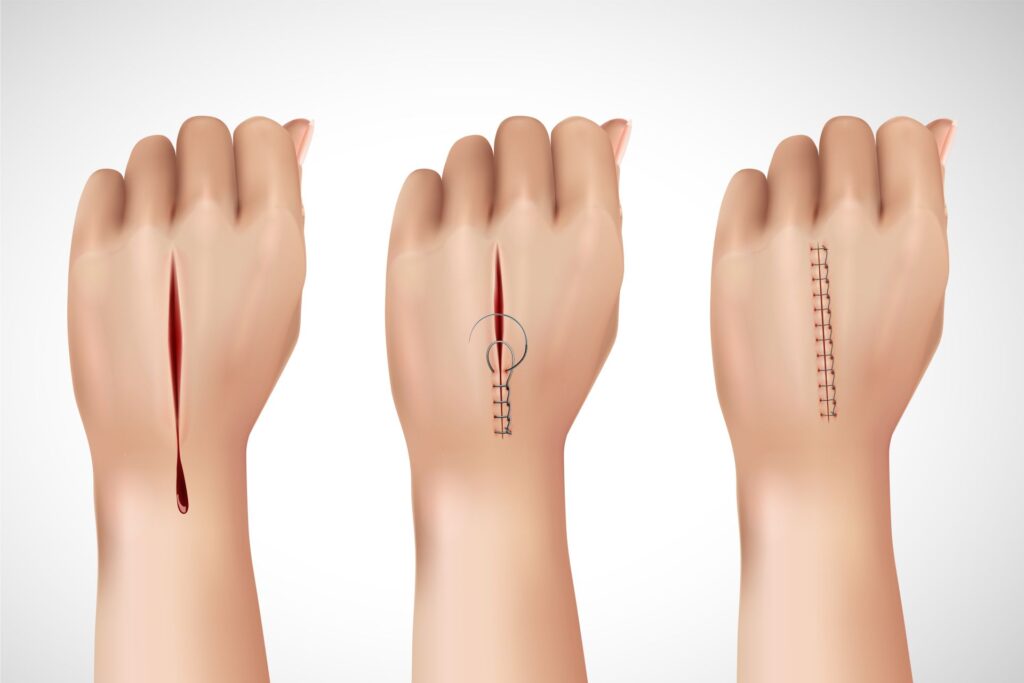
Hand surgery is an area of expertise in the medical field that aims at treating all sorts of disabilities, deformities and diseases of the hand and upper limb region, in order to bring an improvement to the quality of life of those suffering from it. Not all conditions require hand surgery. It may be required in the following conditions:
Injuries: Hand surgery may be required for many traumatic injuries such as burns, fractures, contusions, cuts, and more, in order to restore the damaged tissue and hand functionality.
Nerve Damage: Surgical intervention may be required to rectify any damages to the functionality of the hand and upper limb region that may be caused by nerve damage
Degenerative diseases: Hand surgery plays a vital role in restoring the functionality of hand and upper limb that had deteriorated over time due to factors like aging, genetics, lifestyle, or mental of physical degradation of any kind.
Congenital abnormalities: Individuals that are born with deformities to this region can opt for correction only via hand surgery.
Tumors and cysts: Both benign and malignant types of tumors and cysts in the region can be removed by hand surgery.
Joint problems: Hand surgery may be required to fix joints or for joint prosthesis procedures.
Here are the types of hand surgery listed below
- Carpal Tunnel Release Surgery
- Trigger Finger Release
- Surgery for Dupuytren’s Contracture
- Surgery for De Quervain’s Tenosynovitis
- Tendon Repair and Reconstruction
- Flexor Tendon Repair
- Extensor Tendon Repair
- Nerve Repair and Reconstruction
- Median Nerve Injury Surgery
- Ulnar Nerve Injury Surgery
- Radial Nerve Injury Surgery
- Hand and Finger Fracture Surgery
- Surgery for Thumb Injuries
- Surgery for Hand Arthritis
- Ganglion Cyst Surgery
- Surgery for Hand Infections
- Congenital Hand Surgery
- Microsurgery and Complex Hand Trauma

1. Carpal Tunnel Release Surgery
This surgery is performed to treat the painful condition of carpal tunnel syndrome. This condition is triggered by increased pressure on the median nerve for any reason. The reasons could be traumatic injury, overuse injury, congenital predisposition, and more.
The carpal tunnel is a narrow passageway in the wrist, formed by the bones on the bottom and the transverse carpal ligament across the top of the wrist, through which the median nerve and tendons pass that play a role in the movement of fingers. When the tissues inside the tunnel become swollen for any reason, pressure is applied to the median nerve. This may cause numbness and tingling sensations in the hand, and possibly loss of function if left untreated.
Surgical intervention may be required if a patient does not respond well to nonsurgical treatments, including physical therapy, medicines, wrist splints, steroid shots for dealing with pain and swelling, and use of ergonomic tools at work.
A surgeon cuts some of the tissue to expand the tunnel region, to release pressure on the median nerve.
2. Trigger Finger Release
Trigger finger is a condition in which a finger’s mobility is affected as it stiffens, or a painful snap is experienced when the finger is straightened.
Flexor tendon pulleys attached to the bones in the hands make narrow tunnels through which the tendons pass, which are responsible for finger movement. If the tunnel becomes tighter than usual due to the thickening of its wall, the finger becomes stuck in a bent position. With the passage of time, a nodule may form due to the inflammation of the tendon.
Surgery is performed to correct the finger’s mobility.
3. Surgery for Dupuytren’s Contracture
Dupuytren contracture is a condition in which one or more fingers bend inwards, and there is difficulty in straightening them over time. Though its cause is unknown, it occurs when the tough tissue thickens gradually under the skin of the palm and contracts into cords that pull the fingers down.
Like many other conditions, this one can also worsen over time. It mostly affects the ring finger and the little finger. It affects movement, which may negatively impact the quality of life and daily activities.
There are several procedures done for its correction, including:
Partial fasciectomy: Small cuts are made in the palm creases to remove a small part of the tight tissue cord.
Subtotal palmar fasciectomy: Zigzag cuts are made in the palm and fingers to get rid of the damaged tissue.
Dermofasciectomy: Both the damaged tissue and the skin are removed, and a skin graft is used to seal the area.
Needle aponeurotomy: This is a minimally invasive procedure in which a small needle is used to cut and loosen the cord.
Stitches are removed ten to fourteen days after surgery, whereas full recovery takes about two to three months. Wearing a splint and regular physical therapy is compulsory post-surgery treatment.
4. Surgery for De Quervain’s Tenosynovitis
This painful condition affects two tendons on the thumb side of the wrist. Repetitive hand movements like lifting, gripping or twisting can cause irritation within the protective covering surrounding these tendons, which then may cause the tendons to become swollen and thick. Other causes may include inflammatory arthritis, wrist or tendon injuries resulting in scar tissue that limits tendon movement, and fluid buildup that often occurs in pregnancy due to hormone changes.
The symptoms include pain and/or swelling near the base of the thumb, trouble with thumb and wrist movement when gripping or pinching, and a sticking or catching sensation with thumb movement.
In the corrective procedure, a small incision is made over the first dorsal compartment near the base of the thumb. Then the fibrous roof of the affected tunnel is cut open to allow the tendons to glide freely within the tunnel.
5. Tendon Repair and Reconstruction
Tendon repair and reconstruction are surgeries performed to treat severely injured or damaged tendons. In the tendon repair procedure, an incision is made over the injury, and the torn ends of the tendon are sewn together with stitches, and then the skin is sealed. Tendon reconstruction is performed when the tendon is extremely damaged. A tendon graft is used from another part of the body or an artificial material.
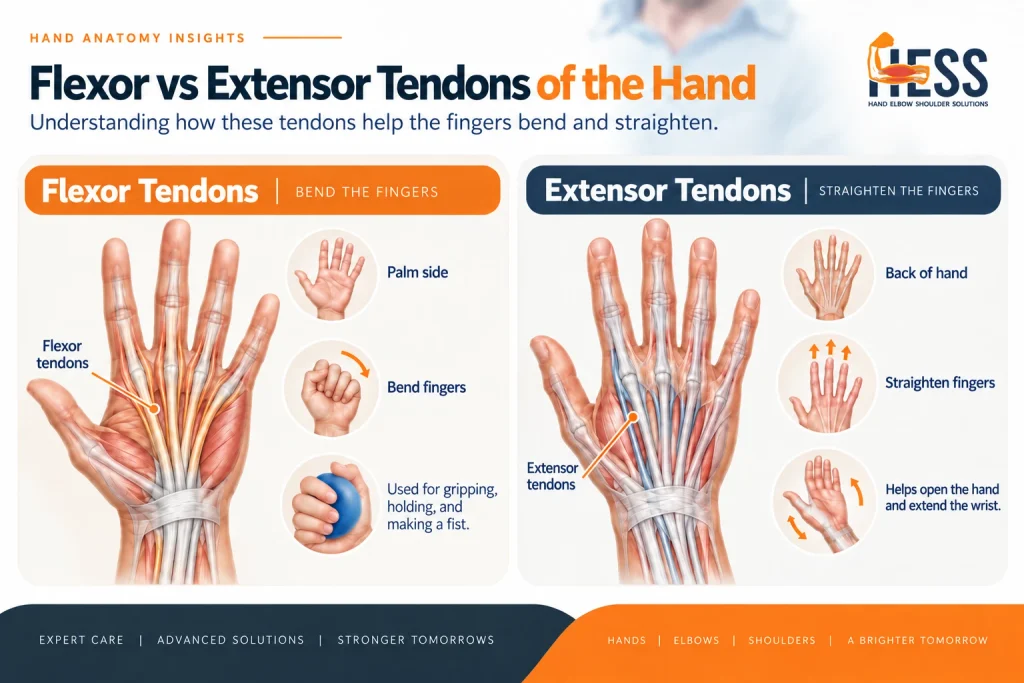
The surgery aims at restoring strength, movement, and stability.
6. Flexor Tendon Repair
Flexor tendons are located on the palm side of the hand and fingers, which help with bending fingers. This plays a core function in movements such as gripping, holding objects or making a fist.
Flexor tendon repair is performed to fix torn or cut tendons in the hand or fingers that allow bending of the fingers.
This procedure is required within two to three weeks of injury where the damage is more than 50%. Prompt surgical intervention is required since they pass through narrow tunnels (i.e. pulleys) and cannot heal on their own.
Strong core sutures are used to stitch the tendon ends together, along with a fine outer stitch for smooth gliding.
7. Extensor Tendon Repair
Extensor tendons are located on the top of hands and fingers, and are responsible for the straightening of the fingers and thumb. Their position is much superficial compared to that of the flexor tendons.
This procedure aims at the restoration of ability to straighten the fingers or wrist after an injury or cut by stitching the torn ends of the tendon together.
8. Nerve Repair and Reconstruction
Nerve repair surgery is required when function and sensation is partially or completely lost due to nerve damage.

9. Median Nerve Injuries
An injury to the median nerve impacts movement and sensation in the thumb, index finger, middle finger and part of ring finger. The causes may include deep cuts at the wrist, elbow fractures or pressure from carpal tunnel syndrome.
Surgery is performed to fix cut nerves or release pressure, when other treatments are ineffective such as splints, medication, and physical therapy.
10. Ulnar Nerve Injuries
The ulnar nerve runs down from the neck to the little finger, and is responsible for fine motor skills in the hand, as well as sensation in the ring and little finger.
The causes of ulnar nerve injuries include cubital tunnel syndrome, Guyon’s Canal syndrome, or direct trauma such as fractures, dislocations or abrupt impact near the elbow or wrist. Basically, the ulnar nerve may be damaged by pressure, stretching, or trauma. Symptoms may include numbness and tingling in the ring and little fingers, weak grip, pain around the inner side of elbow, and ring and little fingers bent inwards in severe cases. Depending on the condition, the following procedures may be performed:
Cubital Tunnel Release: Small cuts are made near the elbow, and tight bands of tissue are divided to release the compressed nerve.
Ulnar Nerve Transposition: The nerve is moved from behind the elbow to the front to prevent it from stretching or catching when the arm is bent.
Nerve repair or reconstruction: For severe traumatic injuries, direct microsurgical repair or nerve grafts may be performed.
11. Radial Nerve Injuries
The radial nerve is a major nerve in the upper limb that is responsible for the movement of the arm, forearm, and hand, and for sensation in the region.
An injury to the radial nerve may cause an inability to lift the hand or fingers. This condition is also commonly known as the ‘wrist drop’. Common causes may include the fracture of the humerus, falling asleep, arm pressure over a chair edge, wrong usage of crutches pressing under the arm, cuts, heavy blows, sports trauma, tight wristwatches compressing the skin, and more.
Surgery is usually required when the nerve is cut, trapped, or is unable to recover on its own for three to six months. The surgical procedures to repair the radial nerve include:
Nerve decompression: To release the compressed nerve from the surrounding tight tissues or muscles.
Nerve repair: To reconnect the torn/cut ends of the nerve directly with fine stitches.
Nerve graft: To bridge a wide gap after the removal of damaged nerve tissue, using a donor nerve section from another part of the body.
Tendon transfer: To restore movement if the nerve cannot be repaired or fails to regrow, by using a healthy functioning tendon from elsewhere in the body, hence restoring wrist and finger extension.
12. Hand and Finger Fracture Surgery
Hand and finger fracture surgery, as the name suggests, is performed to repair broken bones to restore movement and alignment. The surgery is performed if the broken bone is not stable or out of place, the breakage extends into a joint surface, a splint or cast is unable to hold the bone in place, or there is an open wound or rotation defect.

The common surgical methods are as follows:
Closed reduction and pinning: Small metal pins (K-wires) are inserted through the skin to hold bone pieces, without any major cuts.
Open reduction and internal fixation (ORIF): A small incision is made to access the bone, and small plates and screws secure the pieces.
13. Surgery for Thumb Injuries
Thumb injuries require surgery for the repairing of torn ligaments, fix broken bones, or treat severe joint arthritis when other treatments do not work. The common types of thumb surgery include:
Ligament repair – to reconnect torn ligaments with the help of stitches and bone anchors.
Joint reconstruction – to remove damaged arthritic bone at the base of the thumb, using a section of tendon from the wrist to cushion the space.
Joint fusion (Arthrodesis) – to lock the painful joint bones together for pain management and restoring grip strength.
Fracture fixation – to fix broken thumb bones using pins, plates, or screws.
Joint replacement – to replace worn-out joint surfaces with an artificial implant to maintain movement.
14. Surgery for Hand Arthritis
Hand arthritis is the loss of cartilage cushion in fingers, thumb, or wrist joints. This erosion leads to pain, swelling, and stiffness, negatively impacting the quality of life. The common symptoms of hand arthritis include sharp pain in knuckles, fingers, or base of the thumb, stiffness, swelling, warmth, or redness around the joint, weak grip strength, grinding or clicking sounds upon moving fingers, and bumps or changes in shape in the joint.
The main types of hand arthritis are:
Osteoarthritis – the most common form, caused by aging and wear-and-tear of joint cartilage, often targeting the base of the thumb and finger ends.
Rheumatoid Arthritis – an autoimmune disease in which the body attacks the joint lining. It is common for both hands to be affected in this condition.
Surgery is recommended when other treatments are not able to relieve severe pain or prevent functional loss. The main surgical procedures are as follows:
Joint fusion (Arthrodesis)
Joint replacement (Arthroplasty) – The damaged joint is removed and replaced with an artificial implant.
Trapeziectomy – A small trapezium bone at the base of the thumb is removed to treat basal thumb joint arthritis, often using a piece of tendon as a cushion.
Synovectomy – The inflamed lining of a joint is removed to reduce pain and swelling, usually for rheumatoid arthritis.
15. Ganglion Cyst Surgery
A ganglion cyst is a non-cancerous lump filled with fluid that usually forms along the tendons or joints of the wrists or hands. The lump forms under the skin and may change in size. It may cause slight pain or discomfort if any nearby nerve is being compressed to some extent by the cyst. The hand or fingers may also experience numbness or weakness if there is a lot of pressure. A possible cause for this is the leakage of joint fluid due to trauma or repetitive stress on the wrist. However, theses cysts can also form without any apparent reason.
These cysts are operated on for removal. A small cut is made over the lump, and the fluid-filled sac is cut out along with its root that is attached to the joint or tendon, in order to decrease the chances of it growing back.
16. Surgery for Hand Infections
The affected area is opened to drain pus, get rid of dead tissue, and clear bacteria when antibiotics alone are ineffective. Surgery may also be required for deep space infections, where pockets of pus form in closed spaces. Another condition that is a surgical emergency is flexor tenosynovitis, which is the infection inside the tendon sheath of a finger. Septic arthritis or bone infection also reuires direct washouts and bone cleaning.
17. Congenital Hand Surgery
Congenital conditions are structural anomalies present at birth. The ones that require surgery are those that negatively impact function, growth or alignment with growth. Many children with such conditions benefit from corrective surgeries, which are usually performed between the ages of 6 months to 18 months. Common congenital hand conditions that require surgery include:
Syndactyly (Fused digits): Fingers are fused together by skin, soft tissue or bone. Surgery aims at separating the fingers by zigzag cuts and skin grafts for restoration of independent movement.
Polydactyly (Extra digits): Extra finger(s) or thumb is present, which could be as simple as a skin tag, or as developed as a fully formed finger with bones and joints. The extra digit is removed surgically for optimal hand function.
Thumb Hypoplasia or Aplasia: The thumb is extremely underdeveloped (hypoplasia) or not present at all (aplasia). Reconstruction surgery may involve tendon transfers, pollicization (conversion of the index finger to a thumb), or microsurgical tissue transfer.
Amniotic Band Syndrome (Constriction Rings): Fibrous bands of the amniotic sac wrap around a digit in utero, restricting blood supply, leading to tissue damage. Deeper rings need urgent surgical intervention to prevent tissue necrosis or amputation.
Cleft Hand (Central deficiency): There is absence of one or more central digits in the Typical Cleft Hand, resulting in a V-shaped cleft in the center of the hand, often affecting both hands, and this condition is inherited in most cases. Atypical Cleft Hand is characterized by a wider U-shaped gap, and it usually occurs only on one side. This deformity may be caused by genetic mutations, embryological defects, or disruptions in signaling pathways due to exposure to teratogenic chemicals during early pregnancy.
Radial Dysplasia (Radial Clubhand): Severe wrist deviation due to an underdeveloped or absent radius bone on the thumb side of the forearm. Its treatment involves soft tissue release, centralization/radialization of the wrist, and corrective splinting.
Congenital trigger Thumb: The thumb stays stuck in a bent position when the tendon sheath is too tight for the tendon to slide smoothly within. Surgery is performed around the age of one to three years to release the pressure on the tendon if the thumb stays locked.
18. Microsurgery and Complex Hand Trauma
Microsurgery comes into play when blood vessels and nerves smaller than 1 millimeter need to be repaired.